|
 MAINTAINING THE HEAT ELEMENT MAINTAINING THE HEAT ELEMENT
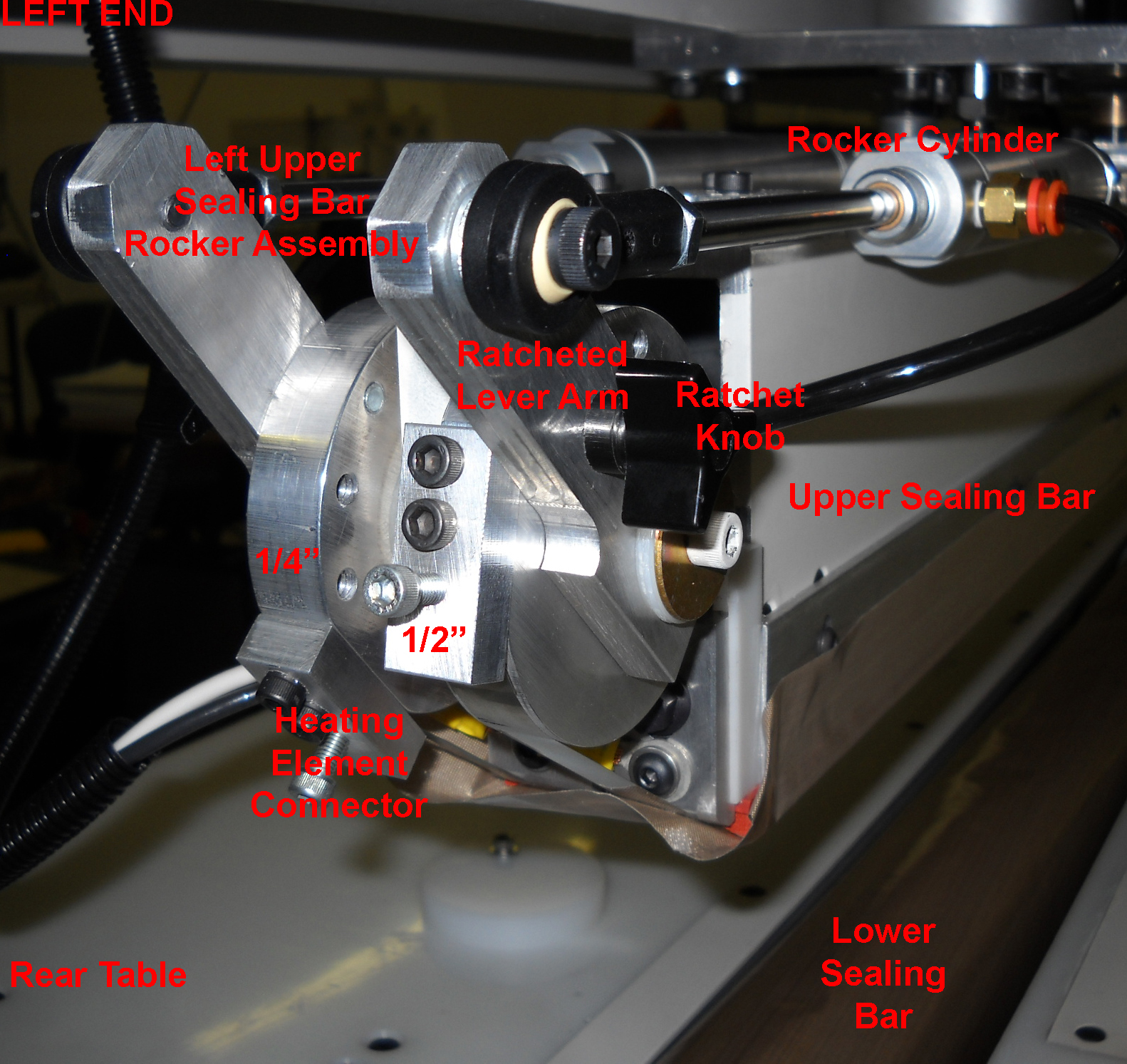
Heating Element is a nichrome flat ribbon wire that is pulsed to create the seal. With each heat seal, the Heating Element expands and contracts. Over time, expansion will exceed contraction. And eventually the position of the Ratcheted Lever Arm will approach the location of the Rocker Cylinder. When the Rocker is under pressure and the Ratcheted Lever Arm appears to be very close to the Rocker Cylinder the Ratcheted Lever Arm has “bottomed-out.” A bottomed-out Heating Element will fail since there is no additional ability for expansion. So basic Rocker maintenance should include a periodic view of the position of each of the four Ratcheted Lever Arms to their respective Rocker Cylinders.
Novaseal’s Ratcheted Lever Arm system provides a quick and easy opportunity to keep the Rocker properly maintained without replacing or removing/adjusting length of the Heating Element. If the Ratcheted Lever Arm position approaches bottom-out (prior to sealing), then proper maintenance would include these steps:
- Turn OFF the Rocker air pressure by turning the Rocker switch located in the Rocker Diagnostic Center to the LEFT or OFF position. Note that the Red Indicator Lamp will remain illuminated while the Rocker Air pressure is off. Which one -- Top or Bottom, depends on which Heating Element needs to be maintained. Also note that each Rocker assembly manages tension on two different Heating Elements ... 1/4-inch and 1/2-inch element widths.
- Ratcheted Lever Arm has three positions. Position 1, 2, and 3. Position 1 is its initial position. Position 3 is closest to the Heating Element Connector. So, if in the current position, the Ratcheted Lever Arm is in either Position 1 or 2, then proceed to instruction 3. If, on the other hand, the Ratcheted Lever Arm is in Position 3 (closest to Heating Element Connector), then proceed to instruction 2a. Note: when inspecting Ratcheted Lever Arm position, do so on both Heating Elements of each Rocker.
- Remove the Heating Element from the Heating Element Connector by loosening the two black screws and gently removing the silver screw, gently remove Heating Element.
- Loosen and remove Ratchet Knob, and reposition Ratcheted Lever Arm to Position 1. Also make sure that the Rocker Cylinder rod is fully extended. Locate and tighten Ratchet Knob to secure Ratcheted Lever Arm in Position 1.
- Manually pull the excess Heating Element and cut away the excess. Prior to cutting away excess make sure you still have enough Heating Element for a folded insertion of Heating Element into the Heating Element Connector.
- Fold and flatten (using a non-knurled surface of a plier or comparable tool) the folded end of the Heating Element and reinsert Heating Element into Heating Element Connector. First tighten black screws, then carefully tighten silver screw. The silver screw applies pressure to deform the captured Heating Element so that the deformed section does not escape from the Heating Element Connector while under pressure. Tightening the silver screw too much will puncture a hole in the heating element which will decrease its effectiveness in holding the Heating Element. Hand tightening (without a tool) the silver screw may produce best results. For a more detailed method of replacing Heating Element, refer to section entitled “Replacing Heating Element.”
- Proceed to instruction 4.
- Loosen and remove Ratchet Knob, and reposition Ratcheted Lever Arm from Position 1 to Position 2; or from Position 2 to Position 3, whichever applies. Locate and tighten Ratchet Knob to secure Ratcheted Lever Arm.
- Turn ON the Rocker air pressure by turning the Rocker switch located in the Rocker Diagnostic Center to the RIGHT or ON position. Note that the Red Indicator Lamp in the Rocker Diagnostic Center will turn OFF.
There are several reasons that could cause Heating Element failure. They include:
- Wear & Tear. All Heating Elements will eventually wear out.
- Bottomed-out condition caused by failure of Rocker maintenance.
- Sealing thick materials without utilizing the full sealing bar.
- Reduced Rocker air pressure will usually cause Heating Element creases, and creases will lead to failure.
- Too much Rocker air pressure.
Instructions for replacing Heating Element:
- Remove Zoned Teflon Coated Fibreglas (TCF) from respective Sealing Bar. Doing this will expose the broken or damaged Heating Element.
- Turn OFF the Rocker air pressure by turning the Rocker switch located in the Rocker Diagnostic Center to the LEFT or OFF position. Which one -- Top or Bottom, depends on which Heating Element needs to be replaced.
- Loosen the Heating Element Connector block mounting screws. Mounting screws are the two black screws. Next gently loosen the Heating Element Retaining (silver) screw. Remove Heating Element.
- Repeat this step on both sides of the Sealing Bar. Remove and discard damaged Heating Element. Make sure you are only removing the damaged Heating Element. As of this writing, there is no known way to repair creases. It seems the creased area is prone to re-crease.
- Reposition Ratcheted Lever Arm to Position 1 on both ends of the Rocker (Left End and Right End). Locate and secure Ratchet Knob to hold Position 1. Extend Rocker Cylinder rod to be fully extended.
- Carefully unwind Heating Element. Use masking tape to assure Heating Element spool doesn’t unwind more Heating Element than needed for each of the following steps. Start with one Rocker end by folding 1/2-inch of the end of the element and crimping the fold to crease flat.
- Position end such that it is centered on the Heating Element Connector. Gently slide Heating Element under the Heating Element Connector block until it hits the first black mounting screw. While doing this, make sure that the Heating Element Connector block is flush with the side of the Rocker wheel. Tighten both black mounting screws.
- Gently tighten the Heating Element Retaining silver screw until you get slight resistance. Too much tightening will pierce the Heating Element. Proper tightening creates a small dimple or distortion in the Heating Element which resists Heating Element slippage under pressure. One end is done.
- Carefully remove the masking tape holding tension on the Heating Element, and carefully unwind or pay-out the Heating Element along the length of the Sealing Bar using care to cause a crease in the Heating Element. Process is easier for the Lower Sealing Bar. When unwinding element, we suggest using two people. One person unwinding and other person doling out small pieces of masking tape every 2-3 feet to position the element flat (without crease) along the Sealing Bar.
- Cut the Heating Element to length. Re-secure spool with masking tape. Fold and crease/flatten end and secure Heating Element using the same instructions defined in steps 7 and 8.
- Turn ON Rocker pressure. Red Indicator Lamp will turn off. Inspect Rocker Cylinder rod extension. If there is 2-inch or less of available rod extension remaining, the Ratcheted Lever Arm should be repositioned such that the available rod extension is fully extended. If fully extended with Rockers on, then proceed to instruction step 16.
- Turn OFF Rocker pressure. Red Indicator Lamp will turn on. On one end of the Rocker assembly, remove the Ratchet Knob, rotate the Ratcheted Lever Arm to the next position (i.e., from Position 1 to Position 2) and re-install the Ratchet Knob.
- Turn ON Rocker pressure. Red Indicator Lamp will turn off. Inspect the Rocker Cylinder rod extension again.
- If there is still 2-inch or less of available rod extension remaining, then Turn OFF Rocker pressure and reposition the Ratcheted Lever Arm on the opposite end of the machine.
- Turn ON Rocker pressure. Red Indicator Lamp will turn off. Inspect Rocker Cylinder rod extension again and repeat steps again. If repeating steps locates the Ratcheted Lever Arm to Position 3, you may want to consider loosening the Heating Element Connector block, removing one end of the Heating Element. Reposition both ends of the machine to Position 1 along with assuring maximum Rocker Cylinder rod extension. Cut the excess Heating Element and reattaching pre-stretched Heating Element to Heating Element Connector block. By doing this, future maintenance is simplified by moving Ratcheted Lever Arm from Position 1 to 2. Much easier. Prior to proceeding to the next step, assure Rocker pressure is on and the Red Indicator Lamp is OFF.
- Remove the masking tape used to temporarily secure the Heating Element to the Sealing Bar.
- Reinstall the Zoned TCF tape.
|